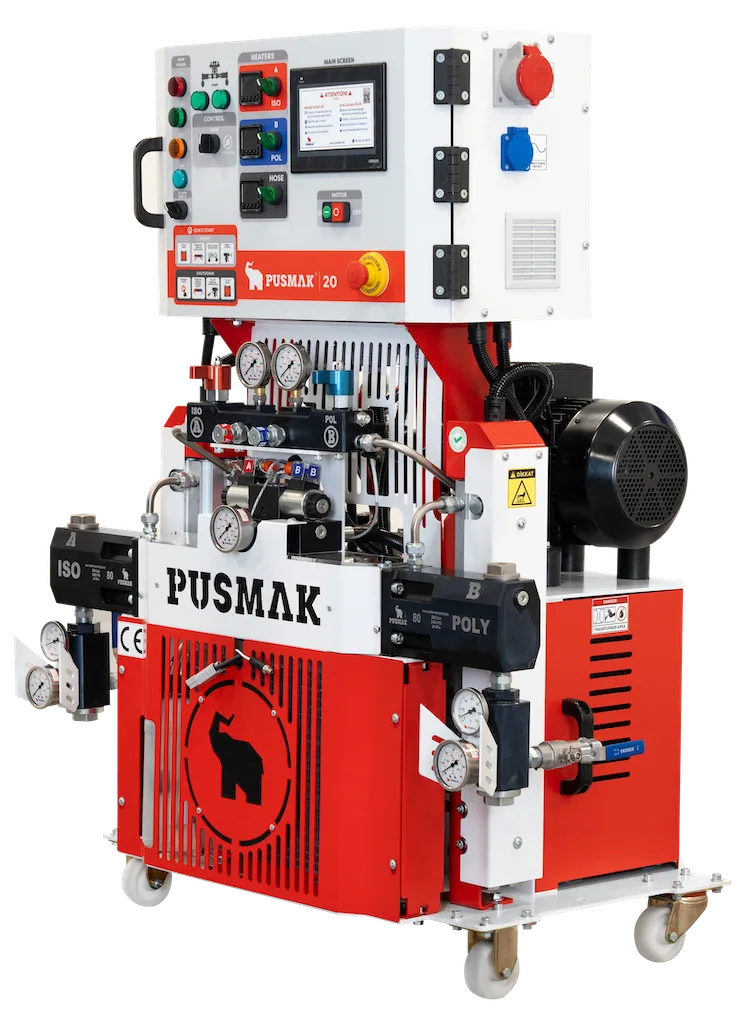
Comparing PUSMAK machines: KPX 20 vs KPX 40 vs KPX 50
If you are looking for a PUSMAK machine comparison to understand the difference between the KPX 20, KPX 40 and KPX 50 before buying a spray foam or polyurea machine, this guide explains the practical differences between the models and helps you choose the right one for your project size, material, required output and site operating requirements.
Choosing the right machine is not just about one model being bigger or more expensive. It depends on the kind of projects you carry out, operating hours, the power available, hose length, and the availability of maintenance, spare parts and technical support after purchase.
Go straight to:
Why compare PUSMAK machines before buying?
A PUSMAK machine comparison before buying helps you avoid choosing a machine that is bigger than you need, or too small for your projects.
Choosing a machine that is too big can mean:
- A higher purchase cost.
- Higher consumption and running costs.
- Not using the machine's full capacity.
- An unnecessary increase in investment.
Choosing a machine that is too small can lead to:
- Lower output.
- Longer operating hours.
- More strain on the machine.
- Project delays.
- Having to upgrade equipment later.
So it is best to start from your project's requirements and then choose the model that fits.
PUSMAK KPX 20: for medium-sized, repeat projects
The KPX 20 is a model worth considering for contractors who need a professional machine for medium-sized insulation projects.
See the PUSMAK KPX 20 specifications for details of the machine and its uses.
It may suit projects such as:
- Villa and apartment building roof insulation.
- Medium-sized insulation projects.
- Contractors' repeat work.
- Projects that do not need the highest output.
- Some spray foam applications, depending on the project's requirements.
Its strength is the balance between capacity and the size of everyday projects.
PUSMAK KPX 40: for more demanding projects
If your projects are larger or need higher performance and continuous professional operation, the KPX 40 is worth comparing.
Review the PUSMAK KPX 40 and its specifications to see what the machine can do and how it is used.
This class may suit you when you have:
- Repeat spray projects.
- Larger areas.
- Polyurea work.
- Daily operation.
- A need for higher performance.
- Commercial or industrial projects.
But the decision should not rest on the model number alone; it should rest on the actual specifications and the project's needs.
PUSMAK KPX 50: for large projects and higher output
The KPX 50 falls among the machines worth considering when output and large areas are the priority.
See the PUSMAK KPX 50 for spray foam work for its specifications.
It may be better suited to:
- Warehouses.
- Hangars.
- Factories.
- Industrial projects.
- Large-area insulation projects.
- Companies that rely on the equipment every day.
The larger the project area and the longer the operating hours, the more output and speed of work matter.
What is the practical difference between the KPX 20, KPX 40 and KPX 50?
The right question is not:
Which machine is more powerful?
It is:
Which machine suits the work I do?
KPX 20
May suit a contractor working on medium-sized projects who wants a professional machine without needing the highest output.
KPX 40
May suit larger projects or work that needs more performance and steadier operation.
KPX 50
May suit companies working on large foam projects that need higher operating rates and output.
Does the material affect the choice of machine?
Yes, and it is one of the most important factors.
Decide whether your business focuses on:
- Polyurethane foam.
- Polyurea.
- Or both.
Foam and polyurea differ in their operating requirements and applications.
Uses of foam
Mostly used for:
- Thermal insulation.
- Roofs.
- Hangars.
- Walls.
- Metal roofs.
Uses of polyurea
Mostly used for:
- Waterproofing.
- Tanks.
- Swimming pools.
- Concrete protection.
- Some industrial applications.
If you plan to work with both materials, make sure the machine is compatible with both before buying.
Flow rate and output
Flow rate is one of the most important specifications when comparing machines.
If your project needs large quantities sprayed every day, higher output can help to:
- Shorten the project.
- Cover a larger area.
- Increase the team's productivity.
- Reduce operating hours.
But there is no point paying more for output you will not use on your projects.
Working pressure
Working pressure matters, but it is not the only factor.
Compare it with:
- Flow rate.
- Heating capacity.
- The material.
- Hose length.
- The spray gun.
The machine with the highest pressure is not always the best for every project.
Heating capacity
Foam and polyurea materials need the right operating conditions.
That is why heating capacity and temperature stability are important points when comparing equipment.
The heating system must suit:
- The material.
- The flow rate.
- The hose length.
- Site conditions.
Power requirements
Before buying any machine, check the power available on the sites where you work.
Ask:
- Is three-phase power available?
- What voltage is required?
- What amperage?
- Will you need a generator?
- Do you often work on new sites?
If your projects are in places without three-phase power, it is also worth considering the PUSMAK GENSET for remote sites.
You can also read the guide to when you need a spray machine with a GENSET generator to see when that system makes more sense than conventional machines.
Hose length
On some projects the machine is far from the spray area.
This happens on:
- Multi-storey buildings.
- Roofs.
- Tanks.
- Large warehouses.
- Industrial projects.
So check the hose length the machine supports before buying.
The greater the distance, the more important managing temperature and pressure becomes.
Ease of moving between projects
If your business means moving constantly between different sites, ease of transport becomes an important factor.
Look at:
- The machine's dimensions.
- Its weight.
- How easy it is to load.
- The space in your vehicle or truck.
- The additional equipment needed.
Sometimes a smaller machine is more practical than a larger one when your projects are spread across many sites.
Is it best to buy the biggest machine?
Not always.
Bigger does not necessarily mean better.
Think about:
- The average area of your projects.
- The number of projects per month.
- Daily operating hours.
- The material.
- The number of crews.
- The operating budget.
If most of your projects are medium-sized, buying a very large machine may not be economical.
What do you need besides the machine?
Whichever model you choose, you will need a complete operating system.
It may include:
- A spray gun.
- Heated hoses.
- Transfer pumps.
- An air compressor, depending on the system.
- A generator where needed.
- Consumable parts.
- Cleaning tools.
- Safety equipment.
- Spare parts.
So do not compare the machine price alone; compare the cost of the complete system.
Why spare parts matter
Having spare parts available in the Kingdom is a very important factor.
A machine can stop because of a small part, but the cost of a stalled project can be large.
It is important to have parts such as:
- Gun parts.
- Filters.
- Pumps.
- Hoses.
- Heating systems.
- Connections.
Local support reduces machine downtime.
Why maintenance matters
Preventive maintenance helps reduce unexpected breakdowns.
The most important tasks are:
- Cleaning the gun.
- Checking the pumps.
- Checking the filters.
- Inspecting the hoses.
- Monitoring pressure.
- Checking temperatures.
- Making sure there are no leaks.
A professional contractor does not wait for the machine to stop completely before maintaining it.
Why training matters
Even the best machine may not perform well if the operator is not trained.
The operator should know how to:
- Start the machine.
- Set the pressure.
- Set the temperature.
- Run the transfer pumps.
- Clean the spray gun.
- Deal with stoppages.
- Shut down correctly.
- Carry out daily maintenance.
Training reduces material waste and protects the equipment.
Quick comparison of the models
| Type of work | Model worth considering |
|---|---|
| Medium-sized projects and repeat insulation work | KPX 20 |
| Larger projects and more demanding applications | KPX 40 |
| Large foam projects and high output | KPX 50 |
| Sites without three-phase power | GENSET |
This table helps narrow the options, but it does not replace reviewing each machine's technical specifications.
PUSMAK machine supply in Saudi Arabia
Trusted Line provides PUSMAK equipment solutions for contractors and companies in Saudi Arabia.
When requesting a machine, it helps to give the sales team information such as:
- The material.
- Project size.
- Operating hours.
- The output required.
- The power available.
- Hose length.
- The type of sites.
This helps choose the machine closest to your needs.
You can also browse the PUSMAK equipment available from Trusted Line and compare the different models before deciding to buy.
Why choose Trusted Line?
Choosing the supplier is as important as choosing the machine itself.
Trusted Line provides equipment-related services, including:
- Equipment supply.
- Spare parts.
- Maintenance.
- Training.
- Technical support.
- After-sales support and warranty.
These services help keep the equipment working and reduce downtime.