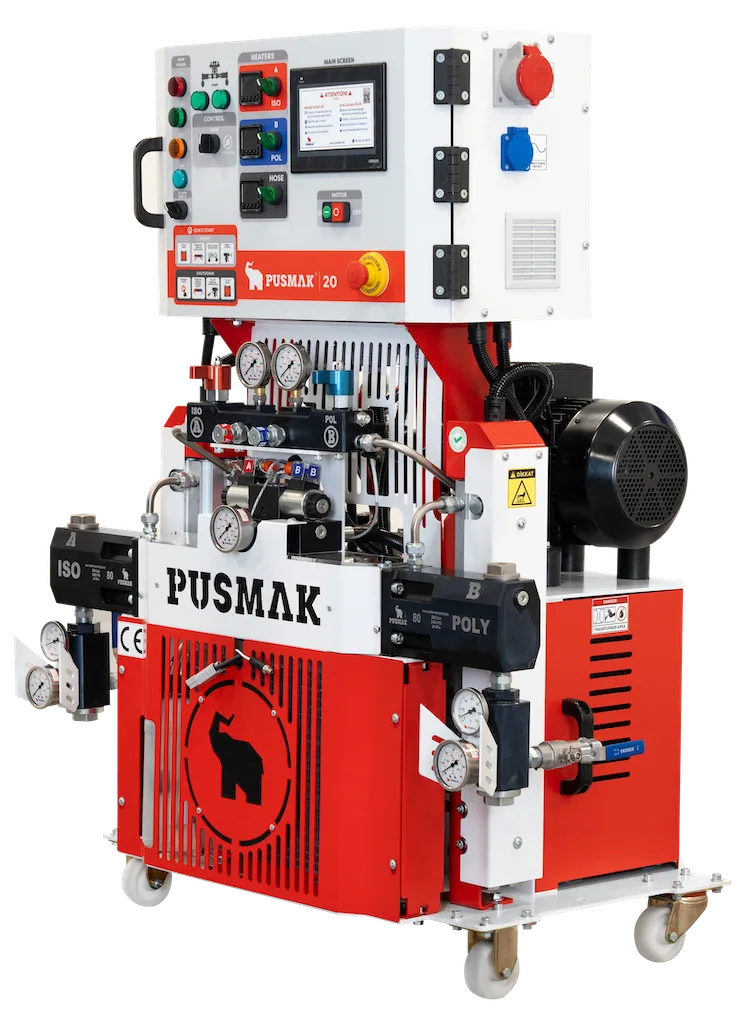
Polyurethane foam and polyurea are often confused because both are sprayed with a two-component machine and both use an isocyanate as component A. But they do very different jobs.
The difference in short
| Polyurethane foam | Polyurea | |
|---|---|---|
| Main job | Thermal insulation | Waterproofing and protective coating |
| Layer | Expanded rigid foam | Flexible membrane (elastomer) |
| Component B | Polyol blend | Amine resin |
| Reaction speed | Fast | Very fast (seconds) |
| Machine pressure in the PUSMAK range | 160–200 bar | 200 bar |
When to use polyurethane foam
When the goal is to reduce heat transfer: insulating roofs, walls, warehouses and cold rooms. Foam fills voids and closes thermal bridges because it expands after spraying.
When to use polyurea
When the goal is to keep water out or protect a surface from corrosion and impact: waterproofing, tank linings, industrial floors and truck beds.
When to use both
Often on roofs: a foam layer for insulation, then a polyurea layer on top to protect it from water, UV and movement. This is where a machine that sprays both pays off.
What it means for choosing a machine
- Foam only: EP 10, KPX 10, KPX 20 or KPX 50.
- Polyurea (and foam): KPX 10+, KPX 20+ or KPX 40.
- Special ratios: PURMIX.
The KPX 20 versus KPX 20+ shows the difference clearly: the first is a foam machine at 160 bar and 9.6 kW preheating; the second handles polyurea and foam at 200 bar and 11.2 kW.