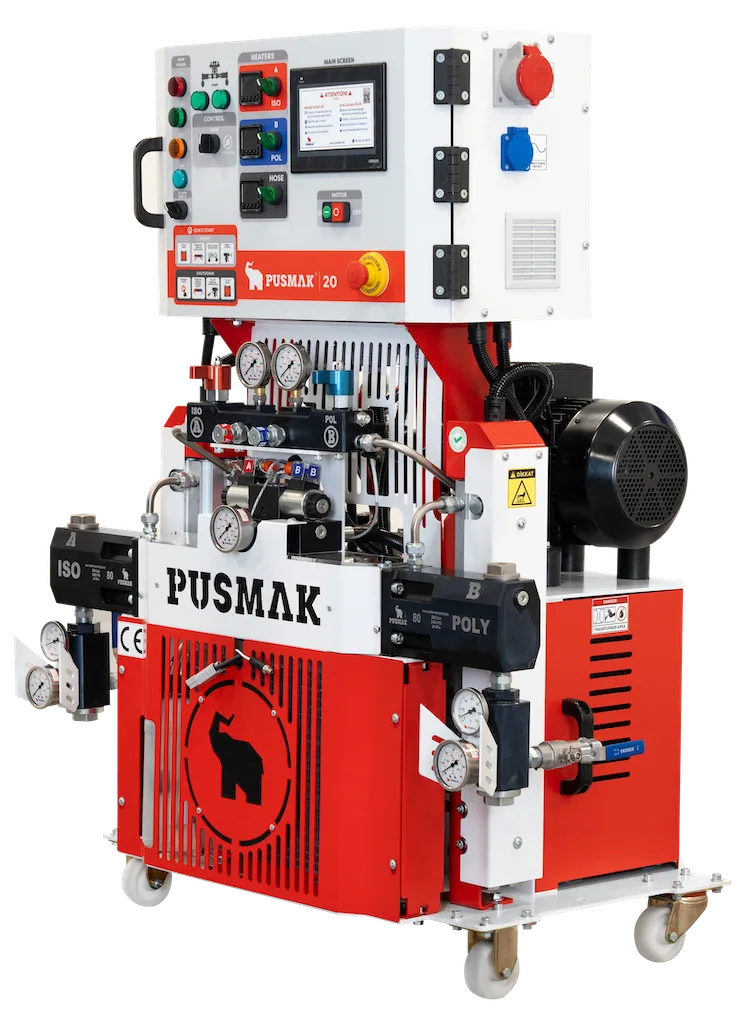
Polyurea is a flexible coating formed by reacting two components: an isocyanate (component A) and an amine-terminated resin (component B). Its defining feature is speed: the material sets within seconds of spraying, forming a continuous, seamless, rubber-like layer.
Where is polyurea used?
- Waterproofing roofs, terraces and foundations
- Lining water tanks and containment basins
- Protective coatings for industrial floors and truck beds
- A protective layer over insulation foam on roofs
Why does it need a special machine?
Because polyurea reacts so quickly, the two components must mix completely in a fraction of a second inside the gun's mixing chamber. That takes:
- Higher pressure: every PUSMAK polyurea machine is rated to a maximum working pressure of 200 bar.
- More heat: 11.2 kW of preheating on the KPX 10+ and KPX 20+, and 12.4 kW on the KPX 40.
- An accurate ratio: any drift shows up immediately in the coating's properties.
Do polyurea machines also spray foam?
Yes. The PUSMAK catalog describes the KPX 10+, KPX 20+, KPX 40 and GENSET as built for both polyurea and spray foam professionals — useful for contractors who insulate a roof with foam and then protect it with polyurea.
How to choose a polyurea machine
Start from the size of your projects: for small to medium jobs the KPX 10+ or KPX 20+ (5.6 kg/min) is enough; for large projects, the KPX 40 delivers up to 10.3 kg/min. If your materials need a ratio other than 1:1, choose the PURMIX.
Compare models on the polyurea machines page, or read polyurea vs polyurethane foam.